
Bergenfield Previous Residents by Era
A backward address trail begins with the source that matches the period being investigated. Modern online land records are a transaction index, while the library’s directories, local manuscript material, and historical maps add household or building context for particular years. The borough’s records do not create one continuous occupancy file. Use the most recent dated instrument or directory first, then move backward only when the parcel, street label, or legal description still matches.
| Source | Years it covers | Where held | What it shows |
|---|---|---|---|
| County Land Records Public Search | January 1, 1970 to present | Bergen County Clerk, Registry Division | Recorded parties, instruments, legal lines, and dates. |
| Older Bergen County deed material | Historical collection path through 1900, with earlier deed material described | NJ State Archives and FamilySearch catalog routes | Earlier deed and mortgage research, subject to collection access. |
| Local printed directories | 1926-1927; 1947; selected 1977 and later community runs | Bergenfield Library finding aid and archive | Dated residential-by-street or community context. |
| Local census material | 1784 manuscript; 1880 Bergenfield transcription | Bergenfield Library holdings | Historical household and landholding clues. |
| Sanborn map selection | 1912, 1923, and 1928 | Princeton University’s map index | Mapped building and address context, not occupants. |
If the question is about a later transfer, start with the County Clerk index. If it concerns an early household, begin with the library finding aid or an archive catalog, then use the property trail to test the address connection. The historical source is always dated evidence, not a current-residence record.
Bergenfield Past Owner Deed Trail
Recorded deeds provide the most dependable sequence for a property’s transfer history. First make sure the address, block and lot, or legal description refer to the same parcel. Then follow each earlier recorded party through the County Clerk index. The online index begins in 1970, so a trail that reaches that boundary must shift to the State Archives or FamilySearch collection path rather than stopping at the online search screen.
- Use the property and parcel routes to capture the exact address, municipality, and block/lot. A tax owner or taxpayer label is a dated reference, not a substitute for recorded title.
- Search the likely current party as a grantee in the Bergen County Land Records Public Search, using Bergenfield and a careful date range when known.
- Record the instrument number, recording date, book/page, legal lines, consideration, and every direct or indirect party shown in the result.
- Search the seller from that instrument as a grantee to locate the earlier acquisition, keeping each link as a separately dated transaction.
- When the chain reaches the online limit, consult the New Jersey State Archives genealogy collections and the county deed catalog route for the older material.
- Grantor
- The party who transfers an interest in a recorded instrument.
- Grantee
- The party who receives an interest in that recorded instrument.
- Chain of title
- The sequence of recorded transfers used to follow a property backward through time.
- Legal description
- The land-identifying wording in a record, often more reliable than a changing street label for historical matching.
Note: Keep recording date and document date separate because they may not be the same event date.
Bergenfield Previous Residents Deed Index
The County Clerk’s BrowserView interface offers party names, additional parties, ALL or ANY name behavior, document type, town, date range, instrument number, book/page, consideration, legal-description lines, lot/block, map, and parcel fields. Use the legal description and block/lot to avoid treating a similar street number as the same property. Results can display instrument type and number, date/time, pages, consideration, party role, notes, linked documents, and image or print controls.
| Visible result detail | Address-history value |
|---|---|
| Instrument type and number | Identifies the recorded document to cite or request. |
| Recording date and book/page | Places the transfer in a dated sequence and returns to the record. |
| Legal lines and parcel fields | Tests whether an older instrument belongs to the same property. |
| Parties and linked documents | Supplies the next dated lead in a carefully documented deed chain. |
The index is public, but a result is not a promise of unrestricted document images. CAPTCHA, a no-image state, an account, cart, payment, or in-office printing can affect the next step. For a defined historical claim, save the indexed citation first and describe any unavailable image or record gap plainly.
The Bergen County land-records landing page is the official starting route for the index.
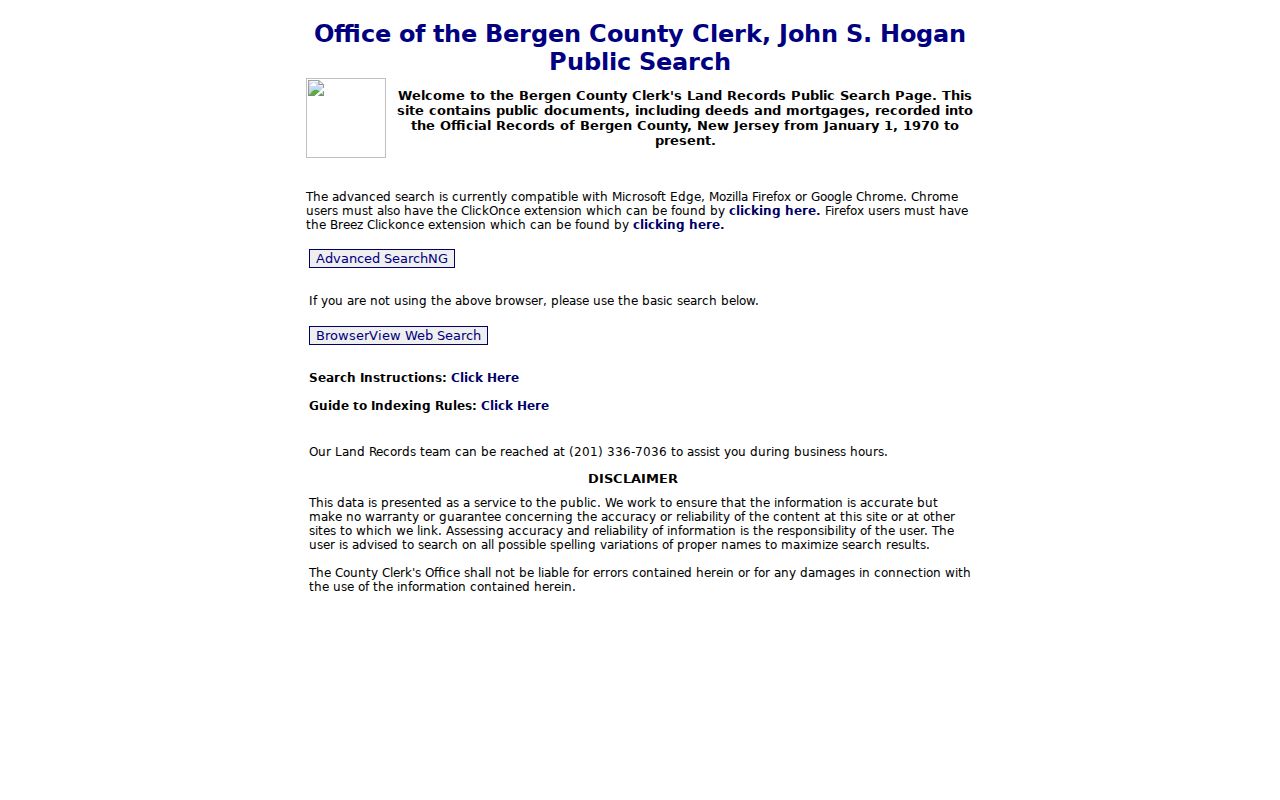
The landing page establishes the County Clerk route; the property-specific evidence remains the particular dated result, its visible fields, and its access conditions.
Bergenfield Previous Resident Search Tip
Research tip. A confusing old number needs a four-source address bridge. Pair the 1926 directory map with Bergenfield’s Chapter 124 numbering rule, the 1996 Street Names item, and the County Clerk legal description. This is more defensible than relying on a modern map label alone. Chapter 124 uses Main Street and Washington Avenue as numbering origins, applies directional prefixes, and places even numbers on southerly or westerly sides.
No complete official renumbering list was found. The absence of a one-to-one number match is therefore a question to investigate, not evidence that an earlier household belonged to a different property.
Bergenfield Address History Maps
Historic maps add building context to the property chain. The Princeton Sanborn Bergenfield selection lists fire-insurance sheets from 1912, 1923, and 1928. A sheet can help establish whether the mapped use was a house, shop, school, church, or another structure during the map’s date. It cannot identify a household merely because a building appears at an address.
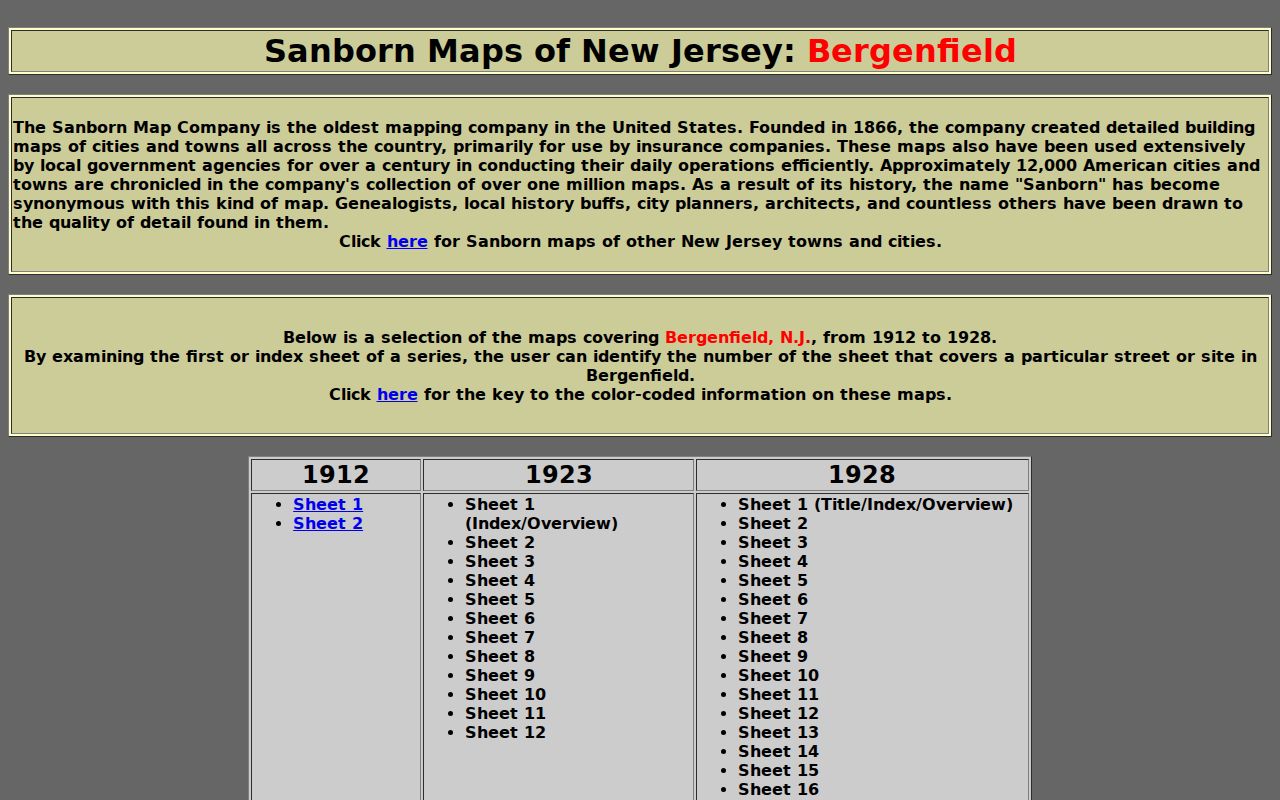
Use a Sanborn sheet alongside the deed description and directory date to test physical continuity, while keeping the map’s building classification separate from any person record.
Bergenfield Past Residents in Directories
Ownership is only one part of address history. The Bergenfield Library finding aid identifies the 1926-1927 Twin Boro Directory as a complete residential directory with Bergenfield and Dumont maps, and the 1947 Know Your Bergenfield as an alphabetical and residential-by-street volume. The 1947 volume is especially useful because the same dated work can support a name-first search and an address-first check. Its result still shows a historical association, not an undisputed household roster.
Pair a directory year with the closest local census material only after the street has been normalized. A practical household flow is: street label and number, then parcel or legal description, then a dated directory listing, then the 1784 manuscript or 1880 transcription if the era fits. Compare surname spelling, relationship clues, dates, and the address context before joining records. The collection descriptions and access routes are detailed on the Bergenfield City Directory page.
The digitized 1926 Twin Boro Directory item documents the directory’s title, publisher, date, format, and residential-directory scope. Its metadata is a reliable record of the collection object, while a legible entry and page number are needed before citing a particular historical listing.
Bergenfield Previous Residents Archive Ends
When a deed chain or directory reaches an older period, the Bergenfield Library archives provide a local starting point for yearbooks, newspapers, photographs, maps, clippings, and finding-aid material. The archive says digitization is ongoing, so a missing online item is not proof that the library does not hold it. Ask reference staff for the named collection, date, and access format rather than requesting a broad search about a person.
The Bergen County Historical Society Library and Archives adds family histories, manuscripts, church and cemetery records, newspapers, maps, photographs, and directory guides by appointment. These sources can help distinguish people with the same surname or explain a household after a death, but they need their own dates and citations. Probate records can add an estate or heir contact on a filing date, not a statement of present residence.
The library finding aid also identifies nearly complete Bergenfield yearbooks from 1943 through 2018, newspaper and photographic material, a 1977 election-district street map, and a 2001 tax map. A yearbook can connect a name to a school year, while a map can test a street label or building location. Neither should be turned into a claim of later occupancy without a record from the relevant period.
Bergenfield Previous Residents Request Route
Some address records are not a web search. The New Jersey Open Public Records Act requires a written request to the correct custodian by mail, hand delivery, electronic means, or agency web form. A phone call does not start the statutory response clock. For a municipal record, name the address or block/lot, the known date range, the department, and the existing record sought. The borough form lists delivery choices, cost authorization, and request-description fields.
The borough reports $0.05 for letter-size copies and $0.07 for legal-size copies, with actual CD/DVD cost and possible delivery or special-service charges. Inspection is generally free. The normal response period is seven business days, subject to lawful extensions and the custodian’s ability to retrieve the record. Ask for the specific permit, map, log, or archive item needed, not a newly created address history.
Note: Preserve the request wording, custodian, submission date, response date, fee notice, and redaction or denial language with the historical notes.
Bergenfield Previous Residents Privacy Limits
House-history research must respect protected information. Daniel’s Law can remove protected home addresses from government websites, and the New Jersey Address Confidentiality Program uses substitute addresses for eligible participants. Voter records have protected-address exclusions. Motor-vehicle information, modern vital records, adoption files, juvenile matters, and sealed or expunged court records follow separate access rules. A redaction, a gap, or an unavailable image should be preserved as a limitation rather than reconstructed from unrelated sources.
Lawful use. Use Bergenfield address history for family history, property history, estate research, and personal curiosity. Do not use historical records to stalk, harass, intimidate, or target any living person.
Public availability and careful use are different questions. State the source, date, record role, and access limit, and avoid publishing unnecessary identifiers or a pattern that could expose a protected person.